Aid agencies say desperate civilians in South Sudan are being cut off from life-saving assistance as fighting intensifies and authorities restrict access to some of the worst-affected areas.
“It was a ‘no’ from local and national authorities and from the military,” said Yashovardhan, head of mission for Doctors Without Borders in South Sudan. “Meanwhile, people are eating leaves and roots to survive.”
The World Food Programme (WFP) confirmed it has also been unable to reach parts of Jonglei state despite repeated attempts, highlighting what aid groups describe as a pattern of humanitarian access being blocked.
Aid caught in conflict
South Sudan has long struggled with the “weaponisation” of aid, with warring sides accused of restricting assistance to areas seen as sympathetic to their rivals. Civilians are often left to bear the brunt.
Tensions have escalated again following the political fallout between President Salva Kiir and his long-time rival Riek Machar, who was suspended as first vice president and placed under house arrest last year. The two previously led opposing sides in a civil war that killed an estimated 400,000 people before a fragile peace deal in 2018.
Recent clashes in Jonglei have displaced thousands, with many fleeing to remote areas such as Nyatim after fighting reached towns like Lankien, where a hospital run by Doctors Without Borders was hit in an aerial attack.
“People began to die”
Among those who fled was pharmacist Thomas Nim, who walked for days through swampland with his pregnant wife, children and elderly mother.
“Some of the most vulnerable… couldn’t make it any farther,” he said, describing how thousands gathered in Nyatim. As conditions worsened, with little food or clean water, he appealed for help — but none arrived.
Aid groups estimate tens of thousands of people may be stranded there, though local officials dispute the figures. Authorities and opposition figures have traded blame over the restrictions, each accusing the other of politicising aid.
Growing humanitarian crisis
Concerns about aid diversion are not new in South Sudan, where armed groups have previously looted humanitarian supplies. During the latest violence, dozens of health facilities have reportedly been ransacked.
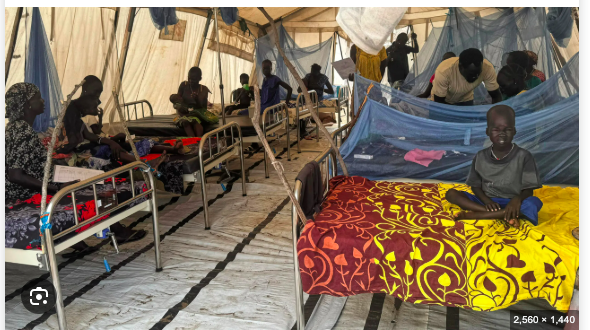
Meanwhile, the crisis is deepening. In some accessible areas, more than half of children screened by aid workers are acutely malnourished, overwhelming already stretched medical services.
With roads and নদ নদ transport routes unsafe or blocked, the WFP has turned to airdrops, delivering hundreds of tonnes of food to reachable مناطق like Chuil. But even there, insecurity persists, with armed men reportedly gathering near aid distribution points, raising fears of further attacks.
For many civilians, the situation has become untenable. Some have begun returning to destroyed homes, despite the risks.
“There was no food and shelter,” said one displaced resident.