
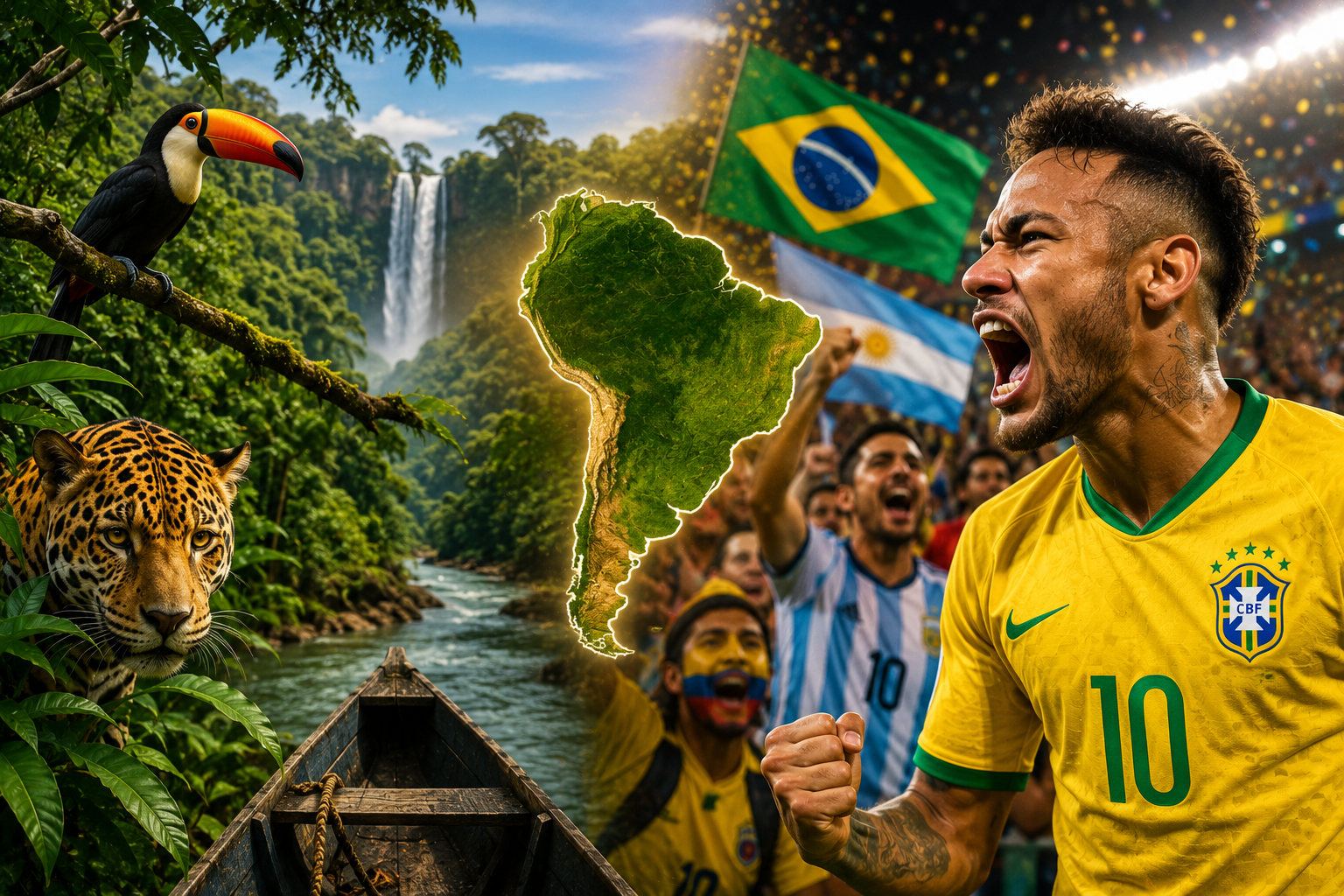
When people think of South America, the first images that often come to mind are the Amazon Rainforest, towering waterfalls, snow-capped Andes, and extraordinary biodiversity. It is a continent that captivates travelers with its untouched wilderness, colorful traditions, and ancient civilizations. Yet to truly understand South America, one must look beyond its breathtaking landscapes. The continent’s identity is shaped just as much by its people, their resilience, and one of their greatest shared passions: sport.
 For many visitors, a journey begins with nature. The Amazon, stretching across nine countries and covering more than 5.5 million square kilometers, is the largest tropical rainforest on Earth. It shelters millions of plant and animal species, thousands of Indigenous communities, and an ecosystem that plays a vital role in regulating the planet’s climate. Exploring these jungles is an unforgettable experience—one that demands preparation, respect for local cultures, and an appreciation of nature’s immense power.
But stepping out of the rainforest and into South America’s towns and cities reveals another side of the continent. Here, football stadiums become cathedrals, neighborhood streets transform into playing fields, and sport becomes a language spoken by millions regardless of age, profession, or social status.
In South America, sport is not simply a weekend activity or a form of entertainment. It is deeply intertwined with history, politics, education, and national identity. Football, in particular, occupies a unique place in society. It is played everywhere—from the beaches of Rio de Janeiro and the mountains of Peru to the barrios of Buenos Aires and the bustling streets of Bogotá. Children often learn to kick a ball before they learn organized rules, dreaming that one day they might follow in the footsteps of legends such as Pelé, Diego Maradona, Lionel Messi, Marta, Ronaldinho, Neymar, James Rodríguez, or Luis Suárez.
This passion extends well beyond professional competition. Families gather around televisions during international tournaments, businesses pause during important matches, and entire cities erupt in celebration after major victories. A football match in South America is not merely ninety minutes of sport; it is a collective emotional experience that reflects pride, belonging, and hope.
Yet the continent’s sporting culture reaches far beyond football. Brazil has produced some of the world’s finest volleyball players. Colombia is internationally recognized for its elite cyclists, who have conquered the highest mountain stages of the Tour de France and Giro d’Italia. Argentina continues to excel in rugby, basketball, polo, and tennis. Ecuador has emerged as a cycling powerhouse, while Peru and Chile have built strong traditions in surfing along the Pacific coast. Across the continent, athletics, boxing, martial arts, swimming, and motorsports continue to grow, supported by young athletes determined to compete on the world stage.
Sport has also become an engine for social transformation. In communities facing poverty or inequality, local clubs and academies often provide young people with opportunities that extend far beyond competition. They teach discipline, teamwork, leadership, and resilience while offering safe spaces where talent can flourish regardless of economic background. Many of South America’s greatest athletes began their journeys on improvised fields, dusty roads, or neighborhood courts with limited resources but unlimited determination.
The same resilience that defines the continent’s people can also be seen in its landscapes. Nature constantly challenges those who explore it, whether navigating dense rainforest trails, climbing Andean peaks, or crossing vast wetlands. Likewise, sport demands perseverance, preparation, and the ability to overcome adversity. These shared values create a powerful connection between South America’s natural environment and its sporting culture.
For travelers, understanding this relationship offers a richer and more authentic experience. Visiting the Amazon reveals the continent’s environmental importance, but attending a local football match, watching children play in a public square, or witnessing the excitement surrounding a national team offers insight into its emotional heartbeat. Together, these experiences tell the story of a region defined by both extraordinary biodiversity and extraordinary human passion.
South America cannot be understood through its landscapes alone, nor solely through its sporting achievements. It is the combination of both that makes the continent unique. Its rainforests remind us of the importance of protecting the natural world, while its athletes and supporters demonstrate the enduring power of perseverance, unity, and hope.
To visit South America is to encounter two remarkable forces: the breathtaking beauty of nature and the unstoppable spirit of its people. Together, they create a continent unlike any other—one where every jungle trail and every stadium tells a story worth discovering.
This version adopts a polished editorial voice with richer context, stronger transitions, and a narrative flow that connects South America’s natural heritage to its sporting culture in a cohesive way.