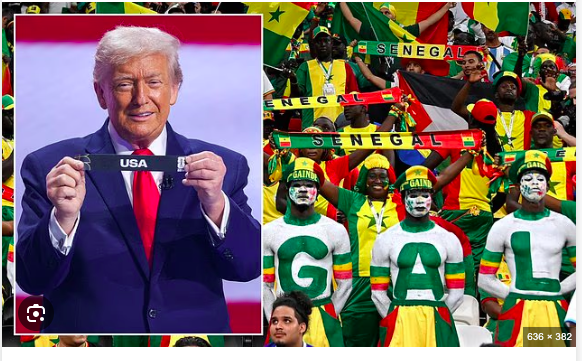
Fans of two of Africa’s football powerhouses, Senegal and Ivory Coast, have seen their World Cup plans thrown into uncertainty by a US travel ban imposed by President Donald Trump.
Both West African nations were added in December to a list of countries facing partial restrictions on entry to the United States, which is co-hosting the June 11–July 19 World Cup with Canada and Mexico. The measures effectively prevent supporters who do not already hold US visas from travelling to attend matches.
At the Africa Cup of Nations in Morocco, fans expressed frustration and disbelief at the restrictions, which come despite their teams qualifying for football’s biggest tournament.
“I don’t understand why the American president would want certain countries’ teams not to be supported by their fans,” Senegal supporter Djibril Gueye told The Associated Press. “If that’s the case, they shouldn’t agree to host the World Cup.”
Trump has said the ban is due to what his administration describes as “screening and vetting deficiencies”. Iran and Haiti — also World Cup qualifiers — are among the countries whose citizens are barred from entering the US under the measures.
While exemptions have been granted for players, team officials and immediate family members, no allowances have been made for ordinary supporters.
“We really want to participate, but we don’t know how,” said Fatou Diedhiou, president of a Senegalese women’s supporters’ group. “For now, all we can do is wait and hope they change their minds.”
Longtime fans say the ban contradicts the spirit of the World Cup. Sheikh Sy, who followed Senegal to the last tournament in Qatar, said travelling with the team is part of their identity. “Since Senegal has qualified, we absolutely have to go,” he said. “We’ve followed our team everywhere.”
Senegal, which has reached the Africa Cup semifinals, opens its World Cup campaign against France at MetLife Stadium in New Jersey on June 16, before facing Norway at the same venue. Its final group match will be played in Toronto on June 26.
Ivory Coast will also play two group matches in the US, opening against Ecuador in Philadelphia on June 14 and returning there for their final group game on June 25, with a match against Germany in Toronto in between.
Ivorian coach Emerse Faé expressed confidence that a solution could be found, noting that visa hurdles ahead of the Africa Cup in Morocco were eventually resolved.
“Football is a celebration,” Faé said. “It would be a real shame, especially since the World Cup only comes every four years, if supporters were prevented from sharing that moment.”
For now, both teams face the prospect of playing in the US with only limited backing from fans who already hold visas, are legal residents, or have dual nationality.
Players say the issue is beyond their control. “It’s not our country — our focus is on the pitch,” Ivory Coast winger Yan Diomande said. Team captain Franck Kessie added that it was up to politicians and football authorities to find a way forward.
Even without the travel ban, cost remains a major barrier. Some fans say ticket prices alone would limit attendance.
One Senegal supporter, who holds French citizenship, said he could travel but has chosen not to, citing both political objections and expense. “They’ve ignored the grassroots fans,” he said.
Ivorian supporter Tan Detopeu echoed that concern. “Even without the ban, very few supporters could afford to go,” she said.