

/
RSS Feed
In Senegal’s remote Kedougou region, a community of chimpanzees has transformed the lives of a group of local men, offering them a path out of dangerous gold mining and into scientific research.
For Michel Tama Sadiakhou, the change came about 15 years ago. Like many young men in Senegal’s far southeast, he once worked in informal gold mines known locally as dioura — a perilous livelihood marked by deep tunnels, toxic gases and frequent cave-ins. Today, he is a senior researcher studying one of the world’s most unusual chimpanzee populations.
Sadiakhou is one of five local researchers, most without a high school diploma, working on the Fongoli Savanna Chimpanzee Project, a long-running study founded in 2001 by US primatologist Jill Pruetz. The project focuses on a small community of West African chimpanzees that live not in dense forests, but in the open savannah along Senegal’s borders with Mali and Guinea.
“It’s really a stroke of luck,” Sadiakhou told AFP. He joined the project in 2009 after seeing researchers pass through his village, despite having never seen a chimpanzee before. Now 37 and a father of four, he describes the apes as his “second family”.
The Fongoli chimpanzees are globally unique. Females in the group are the only animals known to regularly hunt using tools, fashioning branches into spear-like weapons to kill small primates known as bush babies. The chimps’ behaviour has reshaped scientific understanding of primate intelligence and adaptation.
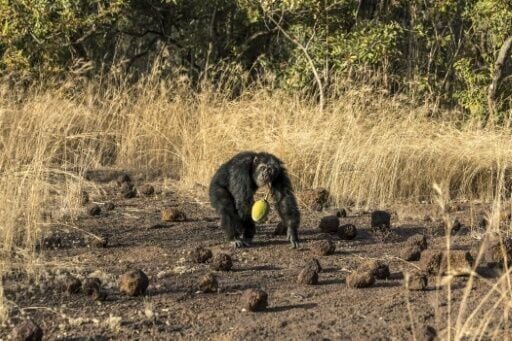
Each day, the research team tracks one of the group’s adult males, recording behaviour every five minutes — from feeding and vocalisations to social interactions and rhythmic tree-beating known as buttress drumming. On one recent morning, a middle-aged chimp named Mike ambled across the savannah, baobab fruit dangling from his mouth, as researchers quietly observed.
All four field researchers and the project manager come from the local Bedik and Bassari communities, where opportunities are limited and gold mining often becomes the default option. Fellow researcher Nazaire Bonnag, 31, said he left the mines after witnessing a fatal accident.
“I saw someone go down into the mine and never come back up,” he told AFP. “When they pulled him out, he had suffocated. I knew I couldn’t continue like that.”
Kedougou accounts for nearly all of Senegal’s gold mining sites and is among the country’s poorest regions, with more than 65 percent of residents living in poverty. More than 30,000 people work in traditional gold mining nationwide, a number that has grown in recent years amid rising gold prices.
The mining boom has brought new threats to the chimpanzees’ habitat, including deforestation, water pollution and the spread of human diseases. Yet the Fongoli chimps — now numbering about 35 — have demonstrated remarkable resilience.
Pruetz’s research has documented their unique adaptations to extreme heat, including soaking in natural pools, resting in caves and remaining calm around fire. Scientists believe these behaviours may offer clues about early human ancestors who lived in similar savannah environments millions of years ago.
Dondo “Johnny” Kante, the project’s manager, says employing local researchers has helped foster community support for conservation.
“When people from here are involved, the community takes an interest,” he said. “With time, this can help protect the chimpanzees and ensure their survival.”
For men like Sadiakhou, the project has done more than advance science — it has rewritten the course of their lives.