

/
RSS Feed
They were pinned down by heavy gunfire with “nowhere to go” when their city in eastern Democratic Republic of Congo fell to the M23 armed group a year ago.
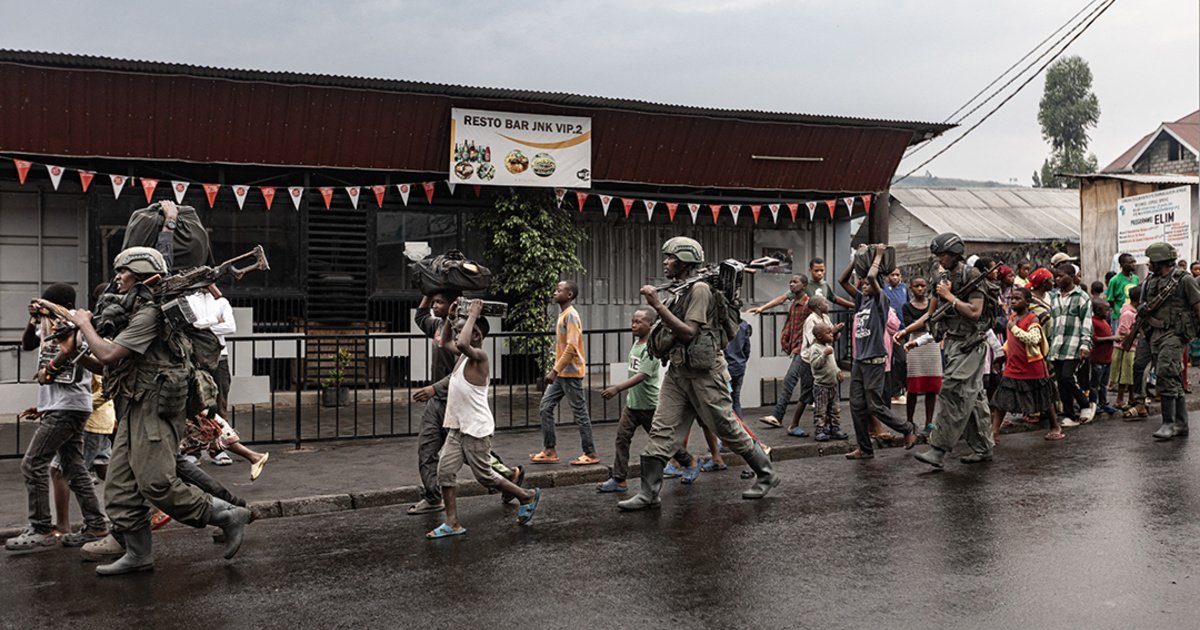
On 26 January last year, nearly one million residents of Goma were confined to their homes as Congolese forces and allied fighters withdrew from the provincial capital. Hundreds of Rwandan soldiers had crossed the border to back the M23 in a swift offensive to seize the lakeside city.
The fighting was intense and deadly. Thousands were killed as shells and bullets tore through neighbourhoods.
Janvier Kamundu, whose name has been changed for security reasons, was sheltering at home with his wife and children when the violence erupted.
“Suddenly I heard my wife cry out,” he recalled. “She had been hit by a stray bullet.”
Neighbours risked their lives to reach the family, eventually finding a vehicle to rush his wife to hospital, where she survived. Medical centres were overwhelmed, and bodies wrapped in white shrouds piled up in morgues across the city.
A year later, residents of Goma are living under what the government describes as “constant oppression” by the M23, according to spokesperson Patrick Muyaya.
An oppressive calm
In the weeks after the city’s capture, Goma emptied at night. Bars and cafés fell silent in a city long accustomed to violence but unprepared for the sudden collapse of authority.
Escaped prisoners, militiamen and soldiers who had avoided capture roamed the streets after dark, breaking into homes and terrorising families. With the police and courts no longer functioning, the M23 launched sweeping security operations.
By late May, hundreds of men sat on the black volcanic gravel in Murambi village on Goma’s northern outskirts, guarded by M23 fighters. Families and community leaders were ordered to identify those considered “respectable”. The rest were detained.
Rough justice
Residents said anyone deemed suspicious risked arrest. People were detained for having dirty clothes or unkempt beards and taken to the city’s sports stadium, which became an open-air prison.
M23 officials periodically invited journalists to observe detainees being categorised. Outside, desperate relatives gathered, pleading for the release of loved ones.
Those not cleared by testimony were reportedly transferred to secret detention sites. Human rights groups documented cases of torture and summary executions.
Over time, however, many residents acknowledged that the streets became relatively safer. Yet with no independent justice system, critics of the M23 faced repression, often accused of links to pro-government militias.
In October, the group began appointing magistrates, but observers said the courts lacked independence.
Despite parallel peace initiatives backed by the United States and Qatar, the M23 launched a fresh offensive in December on the strategic town of Uvira, near the Burundi border.
“These events show that the Rwandan president is not truly committed to the peace processes,” government spokesman Muyaya said.
Life under M23 rule
Most civil society leaders and rights activists fled before the rebels entered Goma. Civilians and former government fighters were forcibly recruited, with the M23 claiming in September to have added 7,000 new members.
The group imposed new taxes to fund its war effort, while the government shut banks in the city to cut off rebel financing. One year on, Goma remains without functioning banks, its airport closed and trade with government-held areas severely restricted.
Civil servants were among the hardest hit.
“Out of about 200 agents, maybe 20 are still working in government-controlled areas,” said urban planning officer Claude Mumbere, whose name was also changed for security reasons. “The rest are here doing nothing.”
Some were subjected to compulsory “ideological training” by the M23.
For Madeleine Mubuto, a mother of three, the impact has been devastating. Her husband lost his job.
“We had saved a little money, which helped at first,” she said. “But after a year, almost all of it is gone.”
With cash scarce, Rwanda’s currency has become widely used in Goma’s markets.
“People keep asking how long this will last,” Kamundu said. “We adapt because we have nowhere else to go.”