

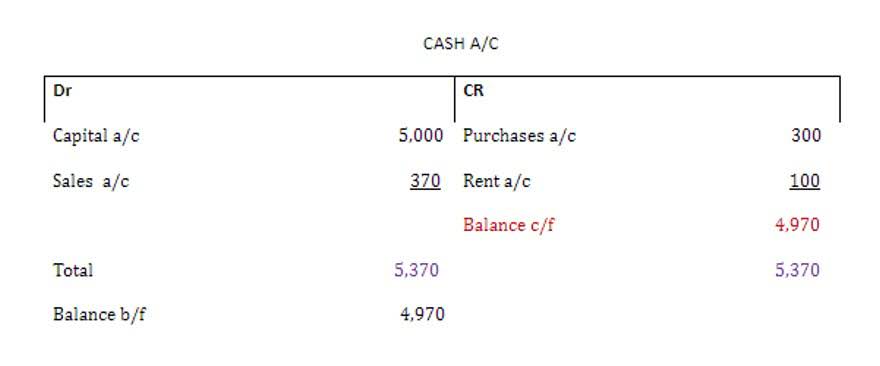
Double entry bookkeeping is an essential tool for businesses of all sizes to keep track of their financial activities and make informed decisions. Furthermore, double-entry accounting ensures accurate financial records by recording every transaction in at least two accounts, keeping the accounting equation balanced. Though more complex, it provides a clear, comprehensive view of a business’s finances, making it ideal for larger businesses or those needing precise financial management.
- For example, if your business secures a bank loan for $20,000, the loan is debited under “Assets” on your balance sheet because it represents an increase in your assets.
- The double entry system is an accounting method that records each financial transaction in two or more accounts.
- A double-entry journal entry is distinct because it records each financial transaction in at least two accounts, ensuring that total debits equal total credits.
- This principle ensures that the flow of assets is accurately captured in the financial records.
- If you apply the rules consistently, you’ll always know your Trial Balance will line up, your reports will make sense, and your audit trail will hold up.
How accounting software automates and streamlines the double entry process
Understanding the relationship between debits and credits is crucial for accurate bookkeeping. It allows accountants to track financial transactions systematically, ensuring that all financial records are complete and reliable. By mastering this concept, individuals can effectively manage and analyze financial data in their organizations.
Double Entry Bookkeeping System: Debit vs. Credit Accounting

Now, we could just make a single entry and record that we received more cash. After you make all the entries for the transaction, check that your books are balanced. Just like it sounds, you record one entry for every transaction with single-entry. If someone tried to falsify a financial report, the dual entry accounting system would detect the discrepancy; that’s why it is used in various industries. That said, accounting fraud statistics show that the system hasn’t eradicated scams entirely. A subsidiary ledger is used to keep track of the details for a specific control account within a company’s general ledger.
Single vs. double-entry bookkeeping

The concept was discovered and formally documented by Luca Pacioli, a monk from Venice who included double-entry in his encyclopedia on math in 1494. It is believed that the publication of Pacioli’s book helped to popularize the idea of double-entry Accounting Periods and Methods bookkeeping. And the credit to the Loan account (a liability account) means this is also increasing. Looking back at our accounting equation above, the left side increases by $50,000 and the right side also increases by that amount. If we didn’t make any further entry, we’d have to guess later on when we looked at our records.
When a transaction occurs, the account that is debited is the account that receives the benefit, while the account that is credited is the account that gives the benefit. For example, when a company purchases inventory on credit, the inventory account is debited (receives the benefit), and the accounts payable account is credited (gives the benefit). In double entry bookkeeping, accounts are classified as either debit accounts or credit accounts. Debit accounts include assets, expenses, and losses, while credit accounts include liabilities, revenues, and gains. This system is essential for businesses as it provides an accurate and reliable way to keep track of financial transactions. It is used by businesses of all sizes, from small startups to large corporations.
Key Benefits of the Double-Entry System in Finance and Accounting:
In double-entry bookkeeping, every financial transaction impacts at least two accounts, which are categorized as assets, liabilities, or equity. Each category plays a specific role in maintaining a balanced accounting equation and accurate financial statements. One of the main challenges of double entry accounting is its initial complexity and learning curve. Understanding the principles, rules, and concepts of debits and credits can be daunting, especially for individuals who are new to accounting. The intricacies of categorizing transactions, double-entry accounting creating journal entries, and maintaining the general ledger require time and effort to grasp. However, with proper education, training, and practice, the learning curve can be overcome.
Who invented double-entry accounting?

A key reason for using double entry accounting is to be able to report assets, liabilities, and https://w2m-trading.net/2025/09/22/what-is-a-commercial-invoice-with-examples-free-2/ equity on the balance sheet. Without double entry accounting, it is only possible to report an income statement. This means that determining the financial position of a business is dependent on the use of double entry accounting.