
Africa is increasingly emerging as a global leader in mobile banking and digital financial services, with innovations developed on the continent offering valuable lessons for more established financial markets, according to Marta Mróz-Sipiora of Polish technology company Asseco Poland.
Speaking to Euronews, Mróz-Sipiora, Director of Global Development and Innovation at Asseco Poland, said African countries were demonstrating how simple, accessible technology could transform financial services and reach millions of people traditionally excluded from formal banking.
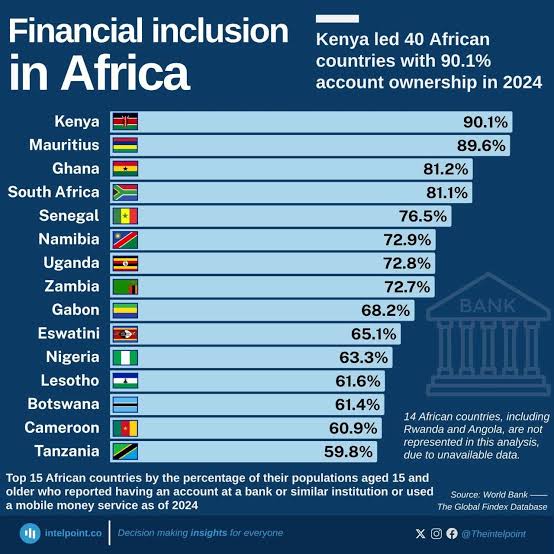
Sub-Saharan Africa has experienced significant growth in financial inclusion over the past decade. According to the World Bank’s Global Findex 2025 report, the proportion of adults with a financial account increased from 34% in 2014 to 58% in 2024.
Mobile money has played a major role in this expansion, with approximately 40% of adults in the region holding mobile money accounts in 2024.
Figures from the GSMA show that Africa recorded 1.1 billion registered mobile money accounts in 2024, representing a 19% increase from the previous year. Of these, 286 million were active monthly accounts.
The platforms processed approximately 81 billion transactions during the year, with a combined value of $1.1 trillion.
Drawing on her experience working with financial institutions in Kenya, South Africa and other African markets, Mróz-Sipiora said the continent had demonstrated that banking services could be delivered effectively without relying entirely on traditional banking infrastructure.
However, financial inclusion remains uneven across the region. World Bank figures show that account ownership reached 90% in Kenya and 89% in Mauritius, compared with just 14% in Niger and 20% in Chad.
M-Pesa: A model of mobile banking innovation
One of the most recognised examples of African financial innovation is M-Pesa, the mobile money service launched by Kenya’s telecommunications company Safaricom.
The platform transformed access to financial services by allowing people to send and receive money using their mobile phones, even without conventional bank accounts.
Mróz-Sipiora said M-Pesa demonstrated how financial services could be integrated into existing mobile networks to provide simple and accessible money transfers.
Its success highlights how technology can address everyday financial challenges, particularly in communities where traditional banking services are limited.
Capitec transforms South Africa’s banking sector
South Africa’s Capitec Bank is another example of how African financial institutions have developed services around customer needs.
Established in 2001 from a microlending business, the bank initially focused on providing financial services to lower-income customers who had limited access to traditional banking.
According to Mróz-Sipiora, Capitec gradually expanded from offering simple loans to developing online and mobile banking platforms.
The bank has since grown into one of South Africa’s largest retail banking institutions, reporting 26 million active clients for the financial year ending February 2026.
She said Capitec’s development demonstrated that sophisticated banking technology does not necessarily require complicated products or customer experiences.
She also questioned the approach taken by some European banks, arguing that their mobile applications often contain numerous features that customers rarely use, increasing maintenance costs without necessarily improving services.
Lessons for European banks
Mróz-Sipiora believes European financial institutions could learn from African markets, particularly their focus on simplicity, accessibility and practical solutions.
She highlighted the importance of developing financial products that respond directly to the needs of businesses and entrepreneurs.
One example is a fixed-term deposit that allows businesses to receive interest payments upfront rather than waiting until the end of the deposit period.
This arrangement can provide companies with additional cash flow to cover invoices, finance investments and meet everyday operational expenses, while allowing banks to secure deposits for an agreed period.
She noted that the conditions surrounding early withdrawals, interest repayments and additional charges must be clearly defined to ensure that such products remain attractive and practical.
According to her, innovation does not always require completely new financial products. Reworking existing services to make them more flexible and useful can also deliver significant benefits.
Europe and Africa can learn from each other
Mróz-Sipiora stressed that cooperation between European and African financial institutions should be based on the exchange of knowledge rather than the assumption that innovation flows in only one direction.
She argued that Africa has developed valuable experience in mobile banking, financial inclusion and customer-focused digital services, which European institutions could adapt to their own markets.
Her assessment challenges the traditional perception of Africa as a region simply catching up with developed economies.
Instead, the continent’s experience in mobile money and accessible banking is increasingly providing examples of how financial services can evolve to meet changing customer needs.
As digital banking continues to expand globally, Africa’s innovations could play an increasingly important role in shaping the future of financial services.